
Yampa Valley Beaver Working Group
Have a Beaver Challenge? We Can Help!
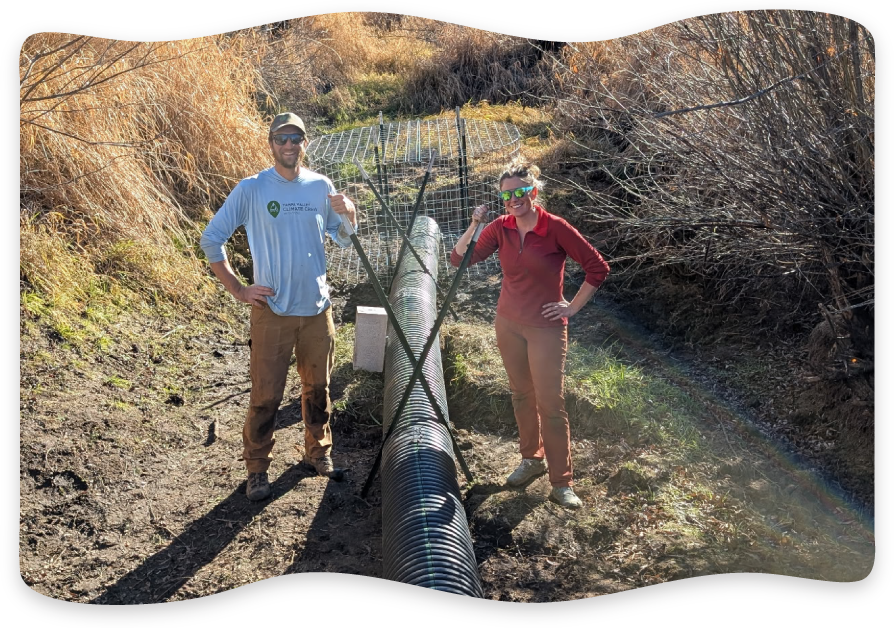
FOTY Conservation Program Manager Emily Burke and Western Resilience Center Watersheds Program Manager Ryan Messinger have completed The Beaver Institute’s BeaverCorps training program to learn how to install coexistence devices. With grant funding and the necessary training, Emily and Ryan now offer these coexistence services to landowners and land managers across the Yampa Valley, requiring just a 25% cost-share fee. Contact us to schedule a site visit!
About The YVBWG
The Yampa Valley Beaver Working Group, led by Friends of the Yampa and Western Resilience Center, is composed of conservation and agricultural nonprofits; federal, state, and local agencies; and nuisance wildlife operators working to manage the resources and health of the Yampa River watershed. The YVBWG was formed in early 2024 to discuss the benefits and challenges related to beavers in the Yampa Valley, which beaver-based restoration methods might be possible in the watershed, which agencies’ current regulations and practices are related to beavers, and where opportunities for collaboration exist.
Today, the YVBWG focuses on coexistence and education as strategies for supporting both beaver populations and humans in the Yampa Valley. Along with FOTY and Western Resilience Center, members include the City of Steamboat Springs, Colorado Cattlemen’s Agricultural Land Trust, Colorado Crane Conservation Coalition, Colorado Mountain College, Colorado Parks and Wildlife, Community Agriculture Alliance, The Nature Conservancy, River Network, Trout Unlimited, the USDA Animal and Plant Health Inspection Service (APHIS), the US Forest Service, Valley Varmints, and Yampatika.
Why Beavers?
- Drought and flood resilience
- Wildfire mitigation
- Habitat creation/biodiversity
- Water quality improvements
- Carbon sequestration
- Connecting streams to their floodplains by slowing, spreading, and sinking water and thereby raising the water table
- Increased soil and vegetation moisture
Photo Credit: Jeremiah Psiropoulos
Photo Credit: Kim Lennberg, Alba Watershed Consulting
Coexistence: A Solution for Beaver Challenges
- Tree cages: Simple wire mesh cages installed around high-priority woody vegetation to prevent beavers from gnawing down and removing trees and shrubs
- Culvert fences: Fences that keep beavers out of culverts and are designed in such a way as to discourage dam building
- Pond levelers: Devices consisting of a pipe running through a hole dug in a free-standing beaver dam, acting as a permanent leak in the dam so flooding can be limited to a pre-determined level that is amenable to both humans and the beavers
- Fence and pipe devices: Similar to pond levelers but designed to mitigate flooding resulting from beaver dams on culverts
FAQs
What should I do if I have beavers?
Ideally, nothing! If you notice beaver activity on your property, it’s common to want to do something about it. But as long as beavers aren’t creating intolerable conflict, it’s best to leave them be so the Yampa Valley can continue to reap all the benefits that come with their wetland creation and maintenance (and so you can reap the private benefits they provide – see below). Often, humans and beavers can coexist with no intervention for years or decades. However, if a beaver is causing intolerable flooding, blocking critical water infrastructure, or if you’re worried about the loss of trees and shrubs, please contact us!
Will beavers cut down all the trees?
Many people worry that beavers will completely denude all the willows, cottonwoods, and aspens in an area. However, beavers and these species coevolved over millennia, meaning that these plants have evolved adaptations for – and actually benefit from – gnawing by beavers. Additionally, it’s more appropriate to think of beavers as riparian gardeners, harvesting materials from one area and then letting them regenerate before returning. Altogether, because beaver wetlands create ideal habitat for these plant species, beavers have an overall positive impact on their populations.
What benefits can beavers provide to private landowners?
Why do beavers build dams?
What do beavers eat?
Beavers are true herbivores that eat herbaceous plants like cattails, sedges, and rushes when they are available. In the winter when herbaceous plants are scarce, beavers turn to woody species like willow, aspen, and cottonwood, eating the inner bark called the cambium. They do not eat fish.
Do beaver dams create a barrier to fish moving up and downstream?
What’s the difference between a lodge and a dam?
Beavers are rodents, so does that mean they reproduce like crazy?
Do beavers spread giardia?
Can beavers be relocated?
While translocation efforts regularly take place across the country (including audacious attempts to “airdrop” beavers into the Idaho wilderness in the 1940’s), they are not yet commonplace in Colorado. Because beavers can bring diseases along with them to new watersheds, they must be first inspected and cleared of any pathogens at proper facilities prior to relocation. Additionally, they are more likely to survive this process when paired with mates, which can also be done at these facilities (à la Love Island: Lodge Edition). CPW’s recently released Colorado Beaver Conservation and Management strategy helps clarify the processes surrounding translocation.
Contact Us
Resources
See YVBWG Resources
The Beaver Institute: A great resource for general information on beaver ecology and behavior and coexistence techniques, plus an Online Beaver Library where you can search hundreds of vetted beaver articles, videos, and web links.
CPW’s page on beavers: Good source for general beaver information, as well as a link to the recently released Colorado Beaver Conservation and Management Strategy, which provides information on beaver history and ecology in Colorado, population and habitat monitoring, harvest management, habitat restoration, coexistence, and translocation policies.
Eager: Popular science book written by Ben Goldfarb that details the historic loss of beavers during European colonization of North America, the resulting landscape change, and how beavers are now being used to help humans combat climate change, including drought, wildfire, flooding, and biodiversity loss.
Beaver: The North American freshwater climate action plan: A great overview of how beavers and beaver-based restoration can be used to adapt to and mitigate the impacts of climate change.
Colorado Beaver Activity Mapper: An online map for exploring where beaver ponds are clustered across the state and a useful tool for prioritizing stream and beaver restoration opportunities.
Citations
See YVBWG Citations
Naiman RJ, CA Johnston, and JC Kelley. 1988. “Alteration of North American stream by beaver.” Bioscience 38: 753-62.
Pollock MM, G Lewallen, K Woodruff, CE Jogan, and JM Castro, eds. 2015. The Beaver Restoration Guidebook: Working with Beaver to Restore Streams, Wetlands, and Floodplains. Version 1.0. Portland, OR: United States Fish and Wildlife Service, 189 pp.
Seton JR. 1929. Lives of Game Animals, Vol. 4, Part 2, Rodents, Etc. Garden City, NY. Doubleday, Doran.